
Structural engineers may not realise that design detailing decisions can occasionally have significant legal consequences. This is particularly relevant in the redevelopment or extension of existing buildings.
Under the Building Safety Act 2022, whether a building, or part of it, qualifies as a “relevant building” can depend on issues such as whether it is “structurally detached” from adjoining elements, or whether part of a building could be “redeveloped independently”. In practice, that means structural design details can directly influence which parts of a development are covered by the Building Safety Act.
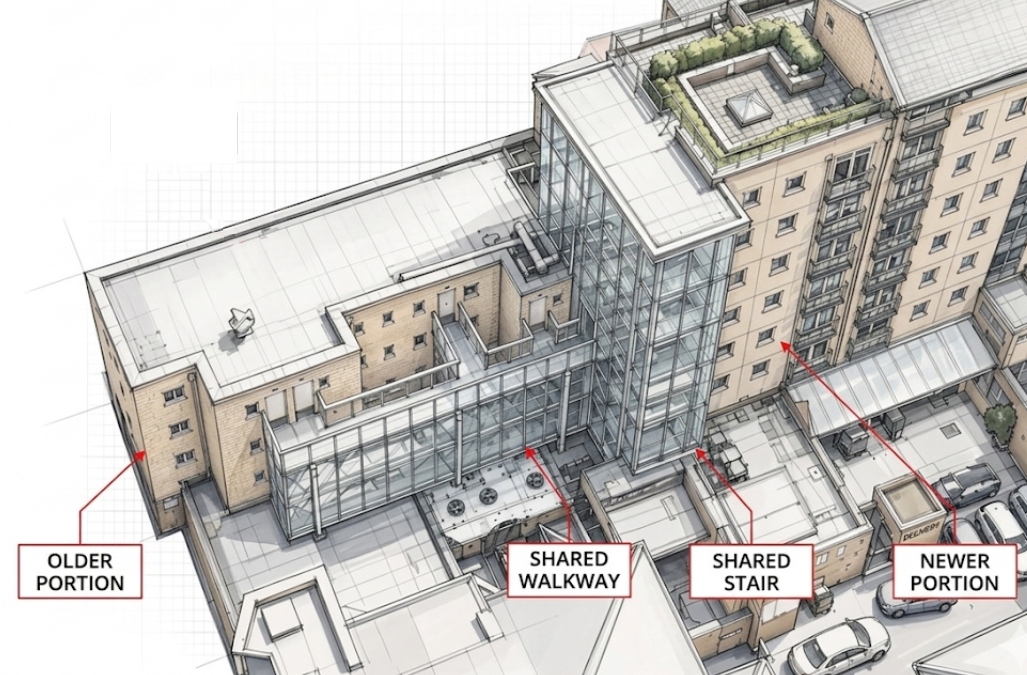
Will Davies, an Associate at William J Marshall & Partners, recently acted as the structural engineering Expert Witness for the Applicant. The associated proceedings resulted in a judgment on a preliminary issue concerning a development in west London. The development comprises the remains of an older, low-rise building alongside newer, taller additions. Only the newer additions exceed the Act’s height thresholds.
The key question for the Tribunal was whether the provisions of the Building Safety Act should extend to the older, shorter parts of the development.
Drawings Are Critical
To this end, the structural engineering drawings proved critical. Not only did they show structural connections between the old and new parts, but they also indicated that some of the taller recent additions were structurally dependent on the remains of the older, low-rise parts of the development. In particular, a shared steel stair and walkway frame incorporates transfer beams supported by both old and new parts of the development.
Importantly, while the arrangement permits a degree of relative movement between old and new parts, separating them would require permanent structural reconfiguration. This would be necessary to maintain safety and functionality of the steel stair and walkway frame.
The Tribunal considered these structural engineering issues alongside building services connections and other factors, ultimately concluding that the remains of the older, lower-rise, building formed part of the same “relevant building” as the taller additions to it. As a result, the provisions of the Act extended to the entirety of the development, rather than to just the newer parts.
For engineers, lawyers, and building professionals alike, the case is a useful reminder that structural engineering detailing decisions can have legal as well as technical consequences. Should you encounter issues like the above or need support, get in touch with the team today. We’ll be glad to assist.